

 English
  日本語
日本語  français
  Deutsch
  Español
  русский
  português
  العربية
  tiếng việt
  ไทย
ไทย  Polska
1. Biological Treatment Zone
The biological treatment zone is the heart of the MBR system, functioning similarly to conventional activated sludge processes but under optimized conditions. Activated sludge, a complex community of bacteria, protozoa, and other microorganisms, degrades organic pollutants measured as Chemical Oxygen Demand (COD) and Biochemical Oxygen Demand (BOD). Advanced configurations often include anoxic and anaerobic zones to achieve nitrogen and phosphorus removal. Nitrification and denitrification processes convert ammonia to nitrate and then to harmless nitrogen gas, while enhanced biological phosphorus removal (EBPR) helps reduce eutrophication risks in receiving waters. The high biomass retention in MBRs supports a more diverse microbial population, improving resilience against toxic shocks and recalcitrant compounds.2. Membrane Filtration Zone
The membrane filtration zone replaces the secondary clarifier entirely. Membranes act as a physical barrier with pore sizes small enough to retain virtually all suspended solids and most microorganisms.| Membrane Type | Pore Size |
|---|---|
| Microfiltration (MF) | 0.1–1.0 μm |
| Ultrafiltration (UF) | 0.01–0.1 μm |
3. Effluent Production
The permeate (filtered water) exiting the membrane module is exceptionally clear with low turbidity, typically below 0.5 NTU, and near-zero suspended solids. This high-quality effluent opens numerous reuse possibilities:Agricultural and landscape irrigation
Industrial cooling water and process water
Toilet flushing in buildings
Feed water for reverse osmosis (RO) systems
Environmental discharge into sensitive ecosystems
Main Components of an MBR System
A complete MBR system comprises several integrated components working in harmony to ensure reliable operation.| Component | Function |
|---|---|
| Biological Reactor | Organic degradation, nutrient removal through microbial activity |
| Membrane Module | Solid-liquid separation, biomass retention |
| Air Blower | Aeration for biological treatment and membrane scouring |
| Pumps | Influent transfer, permeate extraction, sludge recirculation |
| Control System | Automation, real-time monitoring, process optimization |
| Chemical Cleaning System | Membrane fouling control and recovery cleaning |
Types of Membrane Bioreactors
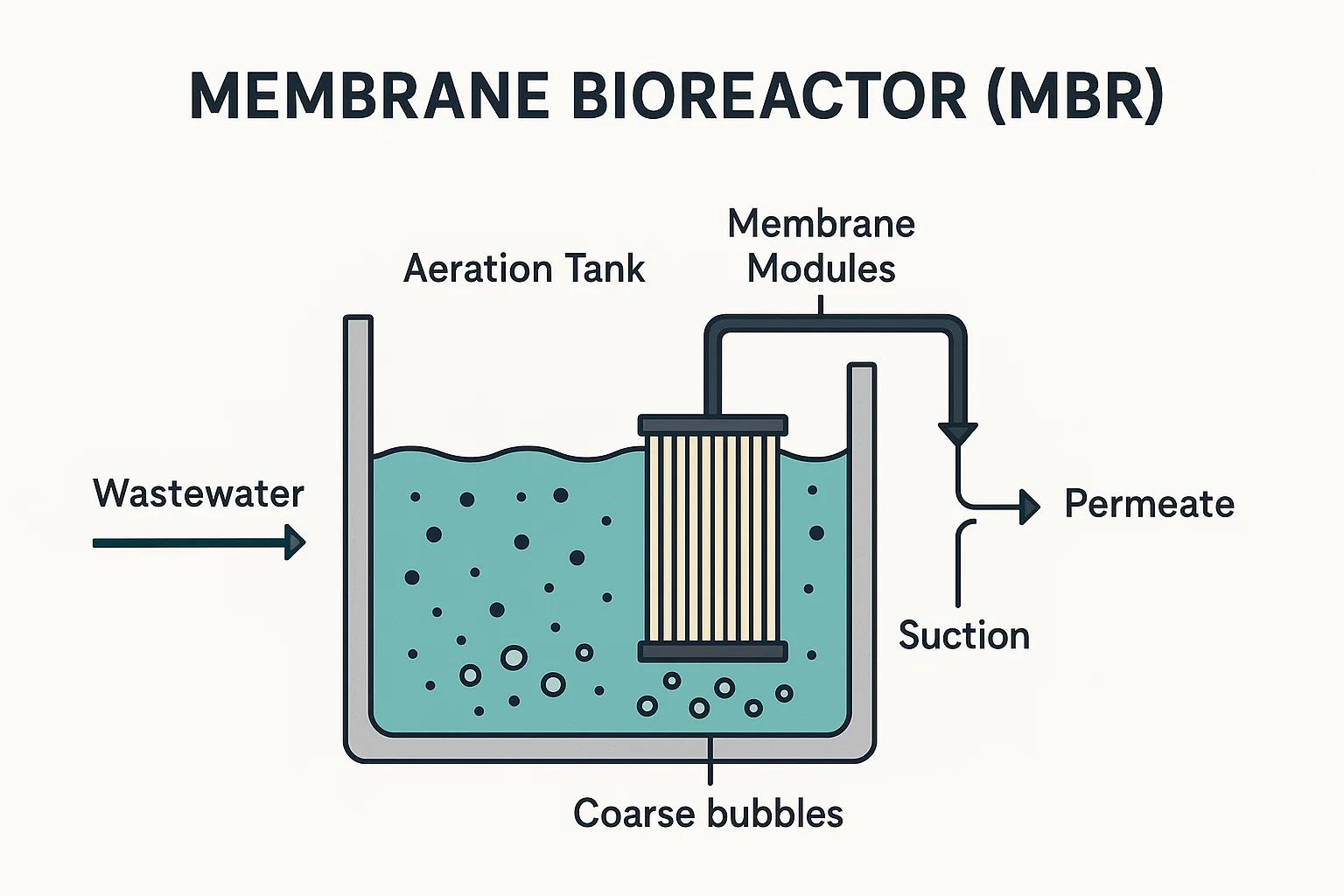
MBR systems are generally classified into two main configurations based on membrane placement: Submerged MBR and Side-Stream MBR. Each has distinct advantages depending on project scale and wastewater characteristics.Submerged MBR (SMBR)
In submerged systems, membrane modules are immersed directly in the aeration tank. Filtration is typically driven by vacuum or low-pressure suction. This configuration benefits from air scouring provided by the same blowers used for aeration, resulting in lower energy consumption. Submerged MBRs are widely used in municipal wastewater treatment plants due to their cost-effectiveness at large scale and relatively lower operating costs.
Side-Stream MBR
Side-stream (or external) MBRs pump the mixed liquor through externally mounted membrane modules under pressure. While they consume more energy, they offer easier membrane access for maintenance and excel in treating high-strength industrial wastewaters. They are particularly suitable for pharmaceutical, chemical, and hospital applications where fouling potential is higher and frequent cleaning or module replacement may be necessary.
Advantages of Membrane Bioreactor Technology
Superior Effluent Quality
MBR systems produce effluent with very low turbidity (often <0.2 NTU), negligible suspended solids, and substantial reduction in bacteria and pathogens. This high purity level exceeds most conventional treatment standards and facilitates safe water reuse.Smaller Footprint
By eliminating large clarifiers and operating at higher MLSS concentrations, MBR plants typically require 30-50% less land area than conventional systems. This advantage is critical for urban wastewater treatment plants, hospitals, and industrial facilities with limited space.Higher Biomass Concentration
MBR systems can maintain MLSS levels of 8,000–15,000 mg/L compared to 2,000–4,000 mg/L in traditional activated sludge processes. Higher biomass translates to greater treatment capacity, improved shock load resistance, and smaller reactor volumes.Better Water Reuse Potential
The excellent effluent quality makes MBR permeate ideal for industrial recycling, cooling towers, landscape irrigation, and even as RO feed water, supporting circular water economy initiatives.Reduced Disinfection Demand
Because membranes effectively retain bacteria, parasites, and many viruses, downstream disinfection requirements are significantly lowered. This reduces chemical usage and operational costs. For sensitive applications like hospital wastewater, pairing MBR with advanced disinfection solutions ensures comprehensive biosafety and regulatory compliance.MBR vs Conventional Activated Sludge
| Parameter | MBR | CAS |
|---|---|---|
| Footprint | Small | Large |
| Effluent Quality | Excellent | Moderate |
| Water Reuse | Easy | Difficult |
| Automation | High | Medium |
| Sludge Settling Dependence | No | Yes |
| Pathogen Removal | High | Medium |
Applications of Membrane Bioreactors
Municipal Wastewater Treatment
MBR technology is increasingly used in urban sewage plants and decentralized treatment systems. Its compact design and superior effluent quality make it ideal for upgrading aging infrastructure or building new plants in densely populated areas where land is scarce and water reuse is prioritized.Industrial Wastewater Treatment
Industries with challenging waste streams benefit greatly from MBR systems. Applications include pharmaceutical manufacturing, food and beverage processing, chemical production, and textile dyeing. The robust biological system combined with membrane filtration effectively handles high organic loads and recalcitrant compounds.Hospital Wastewater Treatment
Hospital wastewater often contains complex mixtures of pathogens, viruses, antibiotic residues, pharmaceutical compounds, and chemical disinfectants. MBR technology provides an effective first barrier by retaining biomass and microorganisms, significantly reducing microbiological risks. When integrated with professional disinfection systems, it enhances overall biosafety and helps facilities meet stringent discharge and reuse regulations.Landfill Leachate Treatment
Landfill leachate is characterized by high COD, ammonia nitrogen, and heavy metals. MBR systems serve as a core biological treatment step, often combined with nanofiltration (NF) or reverse osmosis (RO) for comprehensive pollutant removal and safe discharge or reuse.Challenges and Limitations of MBR Systems
Membrane Fouling
Membrane fouling remains the primary operational challenge, caused by organic matter deposition, biofilm growth, and inorganic scaling. Effective mitigation strategies include optimized air scouring, regular chemical cleaning, understanding anionic polyacrylamide uses in sludge conditioning, advanced pretreatment, and careful selection of membrane materials (such as PVDF for enhanced chemical resistance).
Higher Capital Cost
Initial investment for MBR systems is typically higher than conventional activated sludge plants due to membrane costs. However, savings in land, reduced sludge production, lower disinfection needs, and potential water reuse revenue often result in favorable lifecycle economics.Membrane Replacement
Membranes generally last 5–10 years depending on wastewater quality, operating conditions, and maintenance practices. Proper design and operation can extend service life significantly.How to Select the Right MBR System for Your Wastewater Project
| Question | Consideration |
|---|---|
| Wastewater Type | Municipal / Industrial / Hospital |
| Flow Rate | m³/day (average and peak) |
| Effluent Requirement | Discharge standards or reuse quality |
| Available Space | Limited or Adequate |
| Budget | CAPEX and OPEX balance |
| Future Expansion | Scalability requirements |
Frequently Asked Questions About Membrane Bioreactors
What is the difference between MBR and activated sludge?
The primary difference lies in solid-liquid separation. Conventional activated sludge relies on gravity settling in clarifiers, while MBR uses membranes for physical filtration. This allows MBR to operate at much higher biomass concentrations and produce consistently superior effluent quality.Is MBR better than conventional wastewater treatment?
MBR is generally superior in terms of effluent quality, footprint, and water reuse potential. It excels in applications requiring high treatment standards or limited space, although it may have higher upfront costs. Lifecycle analysis often favors MBR for modern projects.What membrane is used in MBR?
Most MBR systems utilize either microfiltration (MF) or ultrafiltration (UF) membranes, commonly made from PVDF, PES, or ceramic materials. Hollow fiber and flat sheet configurations are the most popular.Can MBR remove bacteria and viruses?
Yes. UF membranes effectively remove bacteria and a significant portion of viruses through size exclusion. Combined with biological treatment and optional disinfection, MBR systems achieve excellent pathogen reduction.What industries use MBR systems?
MBR technology serves municipal wastewater, pharmaceutical, food & beverage, chemical, textile, landfill leachate, and hospital sectors. Its versatility makes it suitable for any application requiring reliable, high-quality treatment.Why Choose Enrosun for Wastewater Treatment and Disinfection Solutions?
Founded in 2002, Enrosun (Chengdu Rosun Disinfection Pharmaceutical Co., Ltd.), as part of the china water treatment chemicals industry ecosystem, has grown into a leading provider of comprehensive wastewater treatment and disinfection solutions. With over 20 years of experience and more than 160 intellectual property rights, Enrosun delivers integrated engineering, equipment, and chemical solutions to clients worldwide across healthcare, municipal, industrial, agricultural, and environmental sectors.
Our Product Categories
Water Treatment Equipment: Including MBR systems, hospital wastewater treatment stations, integrated sewage treatment plants, and water reuse systems. Water Treatment Disinfectants: Effective solutions for wastewater disinfection, secondary effluent polishing, and reclaimed water treatment. Animal Disinfectants: Specialized products for livestock and poultry farm biosecurity. Environment and Surface Cleaning: Professional disinfectants for hospitals, public facilities, and industrial environments. Personal Care Products: Hygiene solutions for healthcare and general protection.Why Global Customers Choose Enrosun
ISO9001 and ISO14001 certified quality management
Export experience to over 30 countries
Deep expertise in hospital wastewater treatment
Integrated equipment + chemical + engineering solutions
Comprehensive technical consulting and O&M services