Your recent searches
Your recent searches will appear here


Membrane filtration is a physical separation process that uses a semi-permeable membrane to remove suspended solids, bacteria, viruses, organic matter, and dissolved contaminants from water. Depending on membrane pore size, the main technologies include microfiltration (MF), ultrafiltration (UF), nanofiltration (NF), and reverse osmosis (RO). These processes are widely applied in municipal wastewater treatment, hospital wastewater treatment, industrial water recycling, drinking water purification, and desalination systems. By providing a reliable physical barrier, membrane filtration delivers consistently high-quality effluent while supporting water reuse and regulatory compliance.
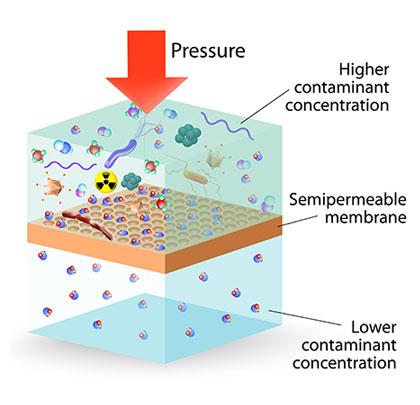
At its core, membrane filtration relies on a selective barrier that permits certain molecules to pass while retaining others. When feed water is forced against the membrane surface, usually under pressure, water molecules and small solutes pass through as permeate, while larger contaminants are rejected and concentrated in the retentate stream. This separation occurs through mechanisms such as size exclusion (sieving), charge repulsion, and solution-diffusion. The membrane acts like an advanced sieve at the microscopic level. In pressure-driven systems, transmembrane pressure (TMP) is the primary force pushing the liquid through. In reverse osmosis, the applied pressure must exceed the natural osmotic pressure to reverse the flow of water.
| Stream | Description |
|---|---|
| Permeate | Treated, purified water that passes through the membrane |
| Concentrate / Retentate | Rejected contaminants and concentrated waste stream |
Effective pretreatment is often necessary to protect the membranes from rapid fouling. Modern systems incorporate automation for backwashing, chemical cleaning, and real-time monitoring to maintain long-term performance.
The primary driving force in most membrane filtration systems is the pressure difference across the membrane. This transmembrane pressure (TMP) forces water through the pores while contaminants are retained. The relationship can be expressed as Flux = Permeability × Pressure Difference, where higher pressure generally increases water production but also raises energy consumption and fouling risks. Different technologies rely on varying pressure levels. Microfiltration and ultrafiltration operate at relatively low pressures, while nanofiltration and especially reverse osmosis require significantly higher pressures to overcome osmotic forces and achieve fine separation.
| Technology | Driving Force |
|---|---|
| Microfiltration | Low pressure |
| Ultrafiltration | Moderate pressure |
| Nanofiltration | High pressure |
| Reverse Osmosis | Very high pressure overcoming osmotic pressure |
System designers must carefully balance pressure, flux, and energy use. Additional forces such as concentration gradients and electrical potential may play supporting roles in specialized applications
.
Microfiltration uses membranes with pore sizes ranging from 0.1 to 10 micrometers. It effectively removes suspended solids, bacteria, algae, and other large particulates. MF is commonly employed as a pretreatment step for more advanced processes or as a standalone solution in drinking water production and municipal wastewater pretreatment. Its relatively low operating pressure makes it energy-efficient for coarse filtration needs.
Ultrafiltration membranes have smaller pores (0.01–0.1 μm) and can remove viruses, colloids, macromolecules, and most bacteria. UF is particularly valuable in hospital wastewater treatment and water reuse projects because it provides a strong physical barrier against microbiological contaminants while operating at moderate pressures.
Nanofiltration bridges the gap between UF and RO. With pore sizes around 0.001 μm, it removes hardness ions, pesticides, organic matter, and color-causing compounds. NF is widely used for water softening and industrial process water treatment where partial salt removal is desired without the high energy cost of full desalination.
Reverse osmosis is the finest membrane technology, capable of removing dissolved salts, heavy metals, PFAS, and a wide range of micropollutants. It requires the highest operating pressures but delivers the highest purity water, making it essential for seawater desalination, ultrapure water production, and zero liquid discharge (ZLD) systems.
| Technology | Pore Size | Primary Contaminants Removed |
|---|---|---|
| MF | 0.1–10 μm | Suspended solids, bacteria |
| UF | 0.01–0.1 μm | Viruses, colloids, proteins |
| NF | ~0.001 μm | Hardness, organics, multivalent ions |
| RO | <0.001 μm | Dissolved salts, heavy metals, micropollutants |
Hollow fiber configurations offer high packing density and large surface area in a compact footprint. They are commonly used in UF systems and membrane bioreactors (MBR) due to their efficiency in handling moderate fouling loads.
Flat sheet or plate-and-frame designs provide excellent mechanical stability and ease of cleaning. They are popular in submerged MBR systems where air scouring helps control fouling.
Tubular membranes excel in treating high suspended solids wastewater. Their wide flow channels reduce clogging and allow effective cross-flow operation in demanding industrial applications.
Spiral wound is the dominant configuration for NF and RO systems. Multiple flat membrane sheets are wound around a central permeate tube, offering high surface area and cost-effective performance for large-scale desalination and purification.
| Parameter | Sand Filter / Conventional | Membrane Filtration |
|---|---|---|
| Particle Removal | Moderate | Excellent |
| Bacteria Removal | Limited | Very High |
| Water Quality Consistency | Variable | Highly Consistent |
| Automation Level | Medium | High |
| Footprint | Large | Compact |
While conventional methods like sand filtration remain useful for coarse removal, membrane technologies provide superior precision, reliability, and adaptability to stringent modern standards.
Membrane filtration delivers consistently high water quality with minimal variation, making it ideal for sensitive applications. Its compact design significantly reduces land requirements compared to traditional treatment plants, lowering civil construction costs. By providing a physical barrier, it often reduces the need for chemical disinfectants and coagulants. The technology also enables safe water reuse for industrial processes, landscape irrigation, and toilet flushing, supporting sustainable water management. High levels of automation make membrane systems suitable for smart water facilities with remote monitoring and predictive maintenance capabilities.
Membrane fouling remains the biggest operational challenge. Organic matter, inorganic scaling, and biological growth can reduce flux and increase energy consumption. Reverse osmosis systems in particular have higher energy demands. Membranes also require periodic replacement every 3–10 years depending on operating conditions, contributing to long-term costs.
Effective pretreatment through coagulation, flocculation, sedimentation, and coarse filtration significantly extends membrane life. Regular chemical cleaning in place (CIP) using sodium hypochlorite, citric acid, alkaline cleaners, and specialized formulations helps restore performance. Strategic use of antiscalants, biocides, and optimized coagulants further controls fouling. Working with experienced partners ensures proper chemical selection tailored to specific water chemistry.
Membrane systems are increasingly used for upgrading existing plants to meet stricter discharge standards and enable water reclamation.
Hospital effluents contain pathogens, viruses, antibiotic residues, blood components, and pharmaceutical compounds. Membrane filtration, especially when combined with MBR and UF technologies, provides robust removal of microbiological and organic contaminants. Integrated with professional disinfection solutions, it helps healthcare facilities achieve high biosafety levels and regulatory compliance.
Pharmaceutical, chemical, food & beverage, and electroplating industries benefit from targeted pollutant removal and water recycling using membrane systems.
Industrial wastewater systems often rely on water treatment chemicals, polyacrylamide (PAM), and anionic polyacrylamide flocculants for solid-liquid separation.
Membrane technologies support zero liquid discharge goals and resource recovery across various sectors.
Begin by thoroughly analyzing source water quality parameters including TSS, COD, turbidity, and salinity. Clearly define treatment objectives — whether for discharge compliance, reuse standards, or high-purity production. Evaluate total operating costs encompassing energy, chemicals, and membrane replacement. Pilot testing and collaboration with experienced water treatment specialists ensure optimal process design, chemical compatibility, and long-term performance.
Established in 2002, Chengdu Rosun Disinfection Pharmaceutical Co., Ltd. (Enrosun) has become has become a leading disinfectant supplier in China, providing comprehensive wastewater treatment, hospital infection control systems, water treatment chemicals, and environmental disinfection technologies. With ISO9001 and ISO14001 certifications and more than 160 intellectual property rights, Enrosun serves clients across multiple continents with reliable, integrated solutions. Our mission — "Makes The Rivers And Earth Cleaner, Helps Billions Of People Be Healthier" — drives our commitment to innovation and customer success.
Water Treatment Equipment: MBR systems, UF systems, RO systems, integrated wastewater treatment equipment, and hospital sewage treatment stations. Water Treatment Disinfectants: Chlorine dioxide, sodium hypochlorite, disinfection tablets, and oxidizing biocides for effluent polishing and membrane cleaning. Animal Disinfectants, Environment and Surface Cleaning, and Personal Care Products: Complete biosecurity and hygiene solutions.
20+ years of specialized industry experience
Proven global project delivery
Customized engineering and integrated equipment + chemical supply
Strong technical support and operation services
Whether you require advanced membrane filtration equipment, hospital wastewater treatment systems, water reuse solutions, or specialized membrane cleaning chemicals, Enrosun delivers tailored solutions that optimize performance and ensure compliance. Contact Enrosun Technical Experts Today for a free water analysis, customized membrane filtration proposal, or to explore our full portfolio of water treatment technologies.
 English
  日本語
日本語  français
  Deutsch
  Español
  русский
  português
  العربية
  tiếng việt
  ไทย
ไทย  Polska